


Teaching with UME
Welcome, Teachers!
UME is designed to support flexible, practical and creative music learning for today’s students and teachers.
There are no memberships, subscriptions or compulsory purchases. Our online framework, syllabus and teaching resources are freely accessible, allowing teachers to integrate UME naturally into their existing teaching approach.
Music Creation Pathway
Teach Creative Music-Making with Confidence
Would you like to introduce composition and original music creation into your lessons, but aren't sure where to begin?
The UME Music Creation Pathway provides a ready-made structure for teaching creative music-making, with guided activities, practical examples and clear assessment goals.
There's no need for a separate composition program or specialist training. The pathway can be incorporated into your existing lessons, using instruments, voice or digital technology.
Each Guided Assessment Pack includes:
Step-by-step creative activities and assessment tasks
Worked examples and supporting audio and video resources
Opportunities for students to explore and develop their own musical ideas
Flexible assessment submissions, with six months to complete
Personalised examiner feedback, a written report and UME certification
Suitable for beginner composers, young musicians and students of all ages, including those with no previous composition experience.
See what's inside! Explore sample activities from our Guided Assessment Packs and discover how easy it is to introduce creative music-making into your lessons.
Sing and Play Pathway
Coming soon!
The UME Sing & Play Pathway supports students in developing the skills to confidently sing and accompany themselves on their chosen instrument. Focusing on coordination, musical independence and expressive performance, the pathway reflects the way many musicians perform in the real world.
Suitable for piano, guitar, ukulele and other accompanying instruments, students work towards recognised certification through flexible video-based assessments and personalised examiner feedback.
Piano Pathway
Teachers are free to use:
their preferred methods
free-choice performance material
contemporary or classical styles
creative and practical musical activities
UME certification is designed to complement what great teachers already do.
Why Today’s Teachers Choose UME
Teachers choose UME because our pathways:
support both classical and contemporary repertoire
encourage creativity and individuality
develop practical real-world musical skills
allow flexibility in programming and pacing
integrate naturally into existing teaching approaches
provide meaningful goals and certification
create a positive and supportive assessment experience
With free-choice repertoire, practical skill development and flexible assessment options, UME helps teachers build confident, versatile musicians - not just exam candidates.
UME pathways are suitable for children, teens, adult learners and lifelong musicians.
Click here for Piano Pathway BOOKING INFO and COSTS
Here is a Piano METHOD BOOK CHART to see how to incorporate UME into what you’re already teaching!
If you’d like to watch a SAMPLE PIANO VIDEO SUBMISSION, click here.
For a sample Piano Report and Certificate, click here.
Recommended Teaching Resource – TopMusic
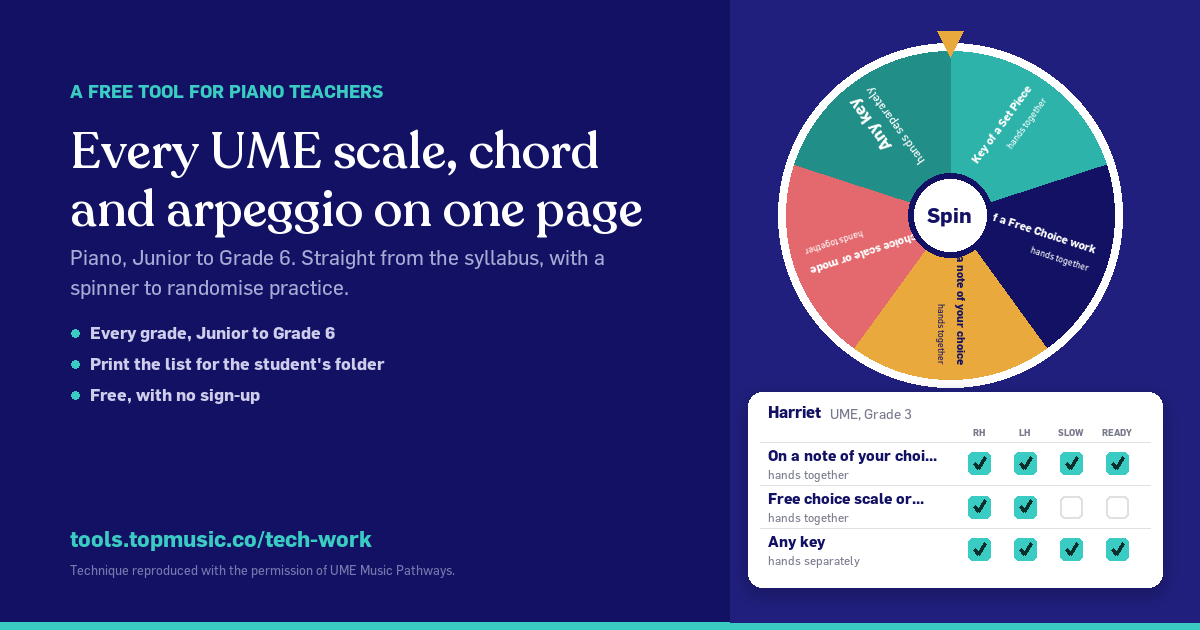
Our friends at TopMusic have developed an interactive Technical Work Finder that includes UME requirements. Teachers and students can explore scales for each level and use the super cool ‘Scale Spinner’ to practice them! Explore UME Technical Work with TopMusic.
Step by Step Teacher Guide for Piano
-
Have a look at our free Piano Pathways Framework and work out which level suits each of your students. For early levels, this method book chart will really help! You can see booking info and pricing here.
Let’s use the ‘Preliminary Piano’ level as an example. Everything you need to know can be found on the Piano Pathways Framework page. There are several things you should take a look at:
Start by reading the Preliminary overview
Then click on the ‘detailed notes’ PDF on the left to see the requirements for each element in Preliminary
Open the PDF of the Preliminary Set Pieces to see the actual music. (These are FREE PIECES - You can print these or send the link to students regardless of whether they’re preparing for an assessment or not.)
You can also click on the videos of the set pieces to help you choose - these are great for sending to students when they’re learning the piece.
-
Once you’ve decided on a level for your student, begin to prepare in lessons
Let the student and parent know which level they are doing and discuss an approximate time frame. Send them the link to the UME website so that they can read all about it. Some teachers like to print out the detailed notes PDF for the level and stick it into the student’s folder or music book - this is great for quick reference for parents as well as teachers.
Here’s a cute ‘planning sheet’ that is a big hit with students. Start with a blank one of these for each student - they love to add to this sheet as their exam material starts to come together!
Use the UME pieces in your lessons. These work well as stand alone material or alongside method books or whatever you’re already using. Just choose pieces from our list that you think your student will enjoy and get started! Gradually decide on which pieces each student will perform for their performance. For levels with ‘free choice pieces’, you can present any piece of a similar difficulty and length to the set pieces. Here’s a useful website with lists of lots of suitable pieces for each level (The books itemised here may not be available globally but keep scrolling - its the lists of pieces that you’re after).
Work through the ‘technical work’ in lessons. The great thing here is that you’ll build the scale list around the keys of their pieces. This is a how you’ll make sure your students are understanding the theory and harmony of the music they’re playing. (Makes much more sense than a random list of scales, right?) Make the most of the ‘free choice’ technical element. Students love scales in 3rds, interesting modes, double octaves for higher levels - anything you like!
Begin looking at the ‘Essential Skills’ section. These are wonderful concepts that are important to learn and fun to teach. We suggest all students cover all skills - but when it comes to the performance, they choose just one essential skill to present. We’ve added additional ‘Essential Skills Examples’ to the Pathways Framework page so that you’ve got plenty of material to use in lessons.
Practise the ‘Score Understanding’ section. It’s fun to incorporate this into lessons - a good ‘off the bench’ activity. We enjoy seeing the student’s presentations of this section and we’re happy for this to be done in an informal style. The requirements are very straightforward and the goal is to help students learn more about their pieces.
-
Decide WHEN to do the assessment
There’s almost no risk in booking with UME, as our rescheduling and cancellation process is so easy! Read more about it here.
Some teachers like to prepare all of their students for assessments at a certain time of the year. Others love the flexibility of being able to work through the material and once a student is ‘ready’, book a date only a few weeks into the future.
Whatever your approach, we suggest that you inform the parent / student that you’d like them to do their assessment and SEND THEM THE LINK and ask them to book. This means that:
The parent / student can select a day that suits them (or a location and day and time if it’s for a live assessment!)
The parent / student pays for the assessment (no need for teacher to be involved in this process)
The parent / student receives confirmation and follow up emails. They will be prompted to enter the teacher email so you should receive all communication as well.
The parent / student can make changes to their booking if they need to - they can reschedule for free by clinking on the ‘change’ button on their booking email.
The cost for each level is on the booking page - you can also find it here.
-
Read through the Performance Guidelines - these are for ALL performances (video submission or in person)
Read through the Video Guidelines if they’re booked for a video submission.
Do a few ‘practice runs’ either in the lesson or at home - playing for a little audience is always wonderful experience.
The Essential Skills pieces for the assessment are emailed out 10 days prior to the chosen date. Watch out for this email and run through these in a lesson leading up to the assessment.
Get all PDF requirements ready. The details of these are on confirmation emails and reminders.
Record or be ready to turn up to the live performance.
-
UME Performance Assessments are marked within a 2 week window - results are usually out about 10 days after the assessment date. Click here for a sample report and certificate.
Discuss how the performance went with your students as soon as you can after they complete it. Questions like ‘How did you feel? / What went well? / Did you have fun?’ tend to get a nice conversation started. We’d suggest that you focus on the positive experience of having learned and prepared all their material and avoid projecting what ‘mark’ they may end up with. After all, the big idea here is setting goals, working well and getting detailed feedback on a report!
When the report arrives, talk through it with your student. We do our best to offer constructive and positive feedback to help with future learning.
Make sure they print their certificate!
Make a fuss of your students, congratulating them on your Facebook page, putting their certificates on your studio wall or announcing them at concerts and recitals.
Share in their success and use it to encourage other families to join your fabulous studio or music school.
-
We encourage all students to learn lots of different pieces in different styles from different sources. To help with this, we’ve got plenty of ‘extras’ on our ‘Additional Resources’ page. There are solo pieces and duets and most of them are free. You can send the link to students to listen and print the music or watch the video for early levels. We add to this page regularly so be sure to check back!
Essential Skills Guidelines
Essential Skills are an important part of a well-rounded music education. Although students present just one Essential Skill in their UME assessment, we encourage them to explore all four as part of their regular lessons.
These are practical, real-world musical skills that are fun to teach, rewarding to learn and useful throughout a musician's life.
-
QUICK STUDY - this is our version of ‘sight reading’. This mirrors ‘real life’ sight reading where musicians are usually given a few minutes to prepare something new before it needs to be performed.
TRANSPOSITION - this is a vital skill which is often overlooked! Basic transposition into other keys is an important real life skill on any instrument and it’s helpful to start early.
IMPROVISATION - whether its creating a piano accompaniment from a chord sequence, or fiddling until you find a melody that you like, everyone wants to be able to improvise!
COMPOSITION - as the levels advance, students may present an entire original piece as their essential skill. We LOVE hearing the creative work of emerging musicians.
-
We’ve added additional ‘Essential Skills Examples’ to the syllabus page to help you teach this section of the exam. Students should work through these with their teachers in regular lessons as part of their curriculum.
10 days before the exam students will receive an email with the actual Essential Skills example for their exam. (All skills will be on the email).
-
Your favourite! Students choose one Essential Skill to present in the exam.
-
It is expected that this section be ‘prepared’ by playing the piece through a few times, but not practiced in the same way as other elements of the exam. The aim is for students to have a working knowledge of the skills and be able to apply that understanding to the given example.
-
Students may use the sheet music for the Essential Skills section - there is no expectation to memorise any essential skill.
-
Students should be ready to announce their chosen Essential Skill as part of their exam, eg: ‘My Essential Skill today is Transposition’ and then proceed to play.